Sea wrack banks
Marine Drift and Wrack Banks on the Western Coast
Coastal EcologyDepending on the location, the western coast of Saarnaki is either purely shingle or covered with wrack. To the north of the landing place lies a section of coast where large amounts of marine drift accumulate – long eelgrass (Zostera marina) and several algae. Among the latter, the main part consists of the largest (up to 40 cm in Estonian waters) and most widespread alga of the rocky bottoms of the Baltic Sea, bladder wrack (Fucus vesiculosus), and a unique intermediate form between attached and loose forms of black carrageen (Furcellaria lumbricalis) growing in the Väinameri.
Vegetation on Wrack Banks and Older Coastal Ridges
Wrack CommunitiesMarine drift is washed ashore by annual storms and floods. In the past, it was taken for fertilizer, but left on the beach, marine drift becomes a habitat for annual plants that prefer nutrient-rich soil, such as grass-leaved orache (Atriplex littoralis), spear-leaved orache (A. prostrata), and sea rocket (Cakile maritima), a crucifer with pale purple flowers and lobed leaves.
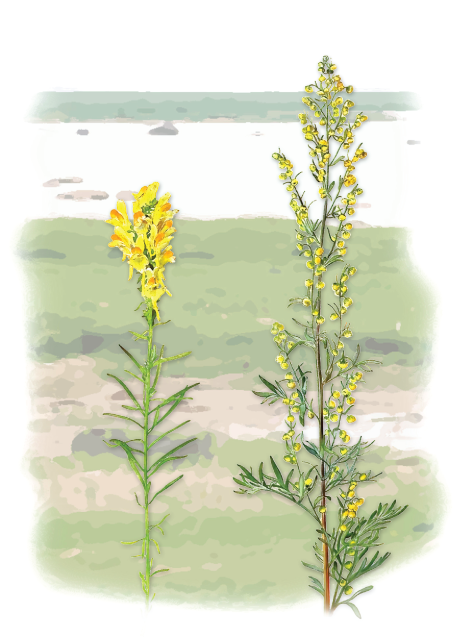
A little further from the influence of the sea, on older coastal ridges, species richness is greater, but three species dominate: sea rocket, common couch (Elymus repens), and wormwood (Artemisia absinthium).
Shingle Beach and Sea Sandwort
Shingle Coast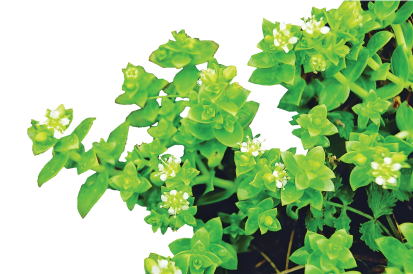
On the shingle beach to the south of the landing place, the vegetation is sparser. A typical species here is sea kale (Crambe maritima) with bluish waxy leaves and white umbel-like inflorescences.
Directly on the gravel grow common toadflax (Linaria vulgaris) with yellow flowers, a relative of the snapdragon, and silverweed (Potentilla anserina) with silvery pinnate leaves.
Closer to the water line grows sea sandwort (Honkenya peploides), which tolerates saline soil thanks to high internal cell pressure and can survive temporary burial under sand. From this shingle beach you can also find broad-leaved pepperweed (Lepidium latifolium) with tiny white flowers and large leaves, which is a Category 4 Red Data Book species.