
Pond
Alvar Juniper Woodland and Dry Alvar Flora
Alvar EcosystemThe alvar juniper woodland begins above the shingle beach. Since this area rose from the sea considerably later than the central part of the islet, a thick humus layer has not had time to form here. This is a dry alvar grassland with a wild thyme - hair-moss community.
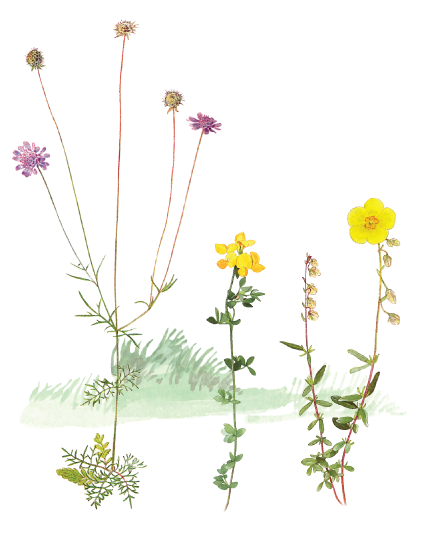
Typical species growing here are creeping thyme and several yellow-flowered plants such as common kidney vetch, common bird's-foot trefoil (Lotus corniculatus), common rock-rose (Helianthemum nummularium) – a subshrub with prostrate stems and leathery leaves, and mouse-ear hawkweed (Pilosella officinarum) with hairy leaves. Tufted vetch, bedstraw, and dwarf milkwort (Polygala amarella) with blue flowers, whose leaves feel somewhat "soapy" when rubbed, are also found here.
Among protected plants, one can see the Category II protected species small scabious (Scabiosa columbaria), whose blue flowers sit in a capitate inflorescence at the tip of the stem. Small scabious is found in Estonia only on the western islands, where it is locally quite a common species.
Orchids of the Juniper Woodland: Fly Orchid and Early Marsh-Orchid
Protected OrchidsOf the orchids, the Category II protected species fly orchid (Ophrys insectifera) grows in the juniper woodland further from the sea, its dark brown flowers resembling insects sitting along the stem.
In lower and moister areas grows the early marsh-orchid (Dactylorchiza incarnata), the most variable in appearance among Estonian orchids. Its height is 10–80 cm; the flowers can range from dark purplish-red to light pink, almost pure white to yellow and even orangeish, with leaves either unmarked or spotted on one or both sides. This species is recognizable by its dense inflorescence of flowers, which are smaller than in our other marsh-orchids and mostly rhombic in shape. It is a fast-developing (from seed to flowering in 4 years) but shorter-lived orchid (Category III protected species).
The Historic Pond and Moor Frog
Wetland & HeritageNear the juniper woodland is a pond, which bears the name Tiik (Pond). Reeds flourish in the pond; open water is visible only during high water.
In the past, the pond was used to keep live fish for the manor. Similar ponds were also in Kaevatsis, Hanikatsi, Salinõmme, and elsewhere. Today, the pond is important for the moor frog (Rana arvalis), which comes here to spawn.
You have reached the end of the Saarnaki Nature Trail!
You have completed all 14 stops along the trail, experiencing Saarnaki's coastal habitats, alvar woodlands, cultural heritage, and wildlife.