Saarnaki Windmill
Post Mill History and Working Mechanism
Built ca 1880We have come full circle back to the farm buildings. A post mill stands on the elevation in the wind, probably built around 1880 (this year was found inscribed on one wooden beam). Grain was ground here until the mid-1950s.
The small post mill, rotated into the wind as a whole on a vertical post (mother tree), is considered the oldest type of windmill in Europe, persisting in western Estonia into the 20th century. Elsewhere, the later so-called Dutch windmill was common, where only the cap of the mill is turned into the wind. In order for the windmill to start working, board shutters or sails had to be attached to its wings and the body turned into the wind using the tail pole.
The grinding mechanism of the two-story mill, with gears and large millstones, was located on the second floor; the ground flour ran into the flour bin or groats box on the first floor. One of the most important parts of the mill is the millstones, which were chiseled out of local erratic boulders by masters dedicated to this craft. As the stones wore down during grinding, the grooves in them had to be cut deeper from time to time. Millstones that had become too thin and light were replaced.
The Saarnaki windmill was renovated in 2003. At that time, the old main post (mother tree) was also replaced, which bears the year 1903 and now rests next to the windmill.
Post Mill Cross-Section and Construction Parts
19 Numbered Parts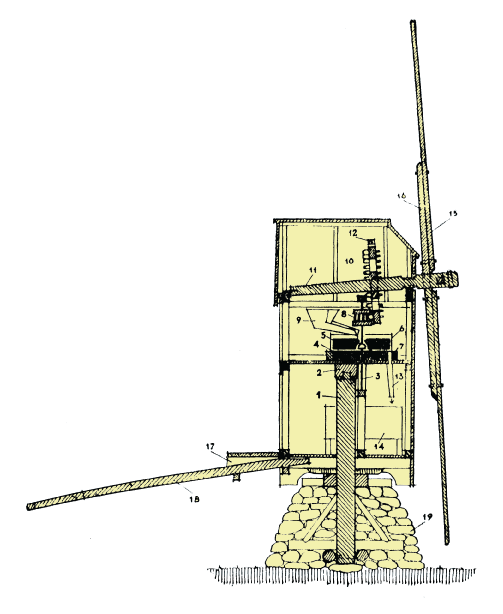
Mill Parts Legend (corresponding to diagram):
View of the Sea and Chain of Islets
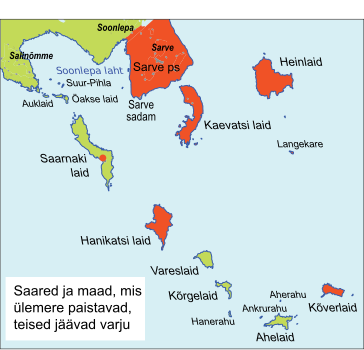
Panoramic ViewFrom the mill, a view opens up to the east of Hiiumaa, together with the port of Sarve, and to the entire chain of islets.
Kaevatsi islet is best visible, and behind it Heinlaid. Further away lies the solitary little Langekare, to the southeast Kõverlaid, and finally neighboring islet Hanikatsi.