Altmäekare
Historical Hayfield and Heritage Landscape
Heritage LandscapeAscending higher from Küniseväli along the Winter Road, after crossing the "border", we arrived from the "world of sheep" back into the "world of people". In front and to the right is a more open area that was and partly still is a hayfield. A former meadow located slightly further away bears the name Altmäekare.
What does the place name "kare" mean?
The word "kare" in the name is common only on the western Estonian islands and in the Väinameri region, meaning "grassland, uncultivated land, fallow, turf, sod". A "kare" can be situated in the middle of the sea as well as on land.
Dry Alvar Meadow Botanical Diversity
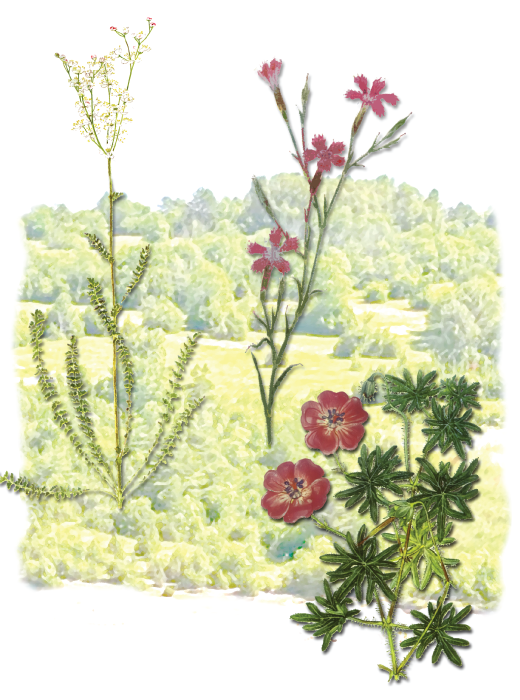
Dry Alvar MeadowSeveral species characteristic of a dry alvar meadow grow on Altmäekare, such as dropwort (Filipendula vulgaris), meadow oat-grass (Helictotrichon pratense), mountain clover (Trifolium montanum) with white honey-scented flower heads, lady's bedstraw (Galium verum) with yellow inflorescences, northern bedstraw (G. boreale) with white flowers and four-leaved whorls, kidney vetch (Anthyllis vulneraria), spiked speedwell (Veronica spicata) with long blue spikes, harebell (Campanula rotundifolia), and hare's-foot clover (Trifolium arvense) with grayish-pink flower tufts.
The most common of our native carnations, the pink-flowered maiden pink (Dianthus deltoides), also grows here. Here and there spread clumps of bloody cranesbill (Geranium sanguineum) with carmine-red and much larger flowers. From the second half of the summer, its leaves turn increasingly reddish and stay vibrant until late autumn.
Of course, on this dry elevation there are also plenty of creamy strawberries (Fragaria viridis), whose berry harvest can be quite impressive in wetter summers.