
Juniper
Common Juniper and Growth Forms (Juniperus communis)
Island SymbolThe common juniper (Juniperus communis) mostly grows as a coniferous shrub several meters tall, more rarely reaching tree size (Estonia's tallest 13.5 m, thickest trunk circumference 1.3 m). The crown shape varies from creeping to pyramidal forms.
Due to small and sharp needles, it tolerates water shortage well and is extremely undemanding regarding habitat. The humid air of the coast and islands and the calcium-rich soil of the alvars suit it well. The stunted growth of herbaceous plants due to the thin soil layer allows the young juniper to develop quite freely here. The common juniper is common throughout Europe, in most of Asia and North America.
The juniper grows slowly, on average 2 cm per year, and thanks to its dense wood containing essential oils, it is quite resistant to fungal rot. Its aromatic and durable wood is valued both for everyday utility objects and souvenirs. A juniper cross can stand on a grave for around 50 years. A juniper can live for over 500 years.
Dioecious Reproduction and Juniper Berries
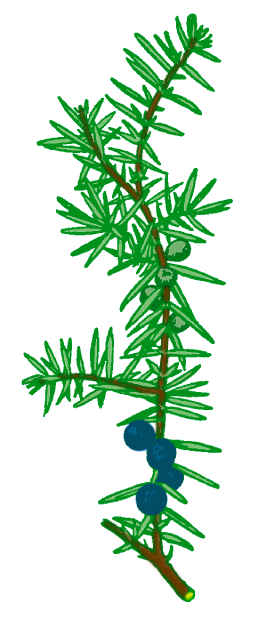
Medicine & FolkloreThe juniper is dioecious. In May-June, yellowish pollen flies from male junipers, after which seeds mature on female plants over two years. In the first year, the berry-like female cone is green; later, its fused fleshy scales turn blackish-blue. The mature cone does not open, and the dispersers of seeds are mainly birds.
Due to their high sugar and resin content and low water content, juniper berries do not freeze in winter. As a medicinal plant, they are used against inflammation of the digestive, excretory, and respiratory systems, but with long-term use, juniper berries begin to irritate kidney tissue. Juniper berries and needles are used to flavor alcoholic beverages and meat dishes.
Folklore of the Juniper Berry Cross
At the tip of the juniper berry is a cross, which is formed from the fusion of the cone scales. Folk tradition has explained the beneficial effect of juniper with this, because where a cross stands, the devil stays away.