
Grazing
Border Crossing & Historical Fences
84-hectare sheep realmSo, dear guest, we have reached the border crossing point! Beyond the border lies the 84-hectare "world of sheep". The border between the "world of sheep and the world of people" is a rail fence (korendusaed), which for the most part matches the old stone walls. In earlier times as well, fences were built around buildings, fields, and meadows to keep livestock away. Of fences, the islet has stone, rail, and mixed fences (lower part of stone, upper part of rails or mesh). Fences were mainly built around the farmsteads, but they are also found further away.
To get over the fence without breaking it, a ladder-like crossing has been built, called koopel in Saaremaa, and kojandus, kojandi, or kaandu in Hiiumaa. Other methods were also used. Sometimes a stone was placed near the fence on either side, or a wooden fork was driven into the ground on both sides of the fence to support a pole pushed through the fence rails, stepping on which made climbing over the fence easier.
Grazing & Meadow Maintenance
Semi-natural habitat conservation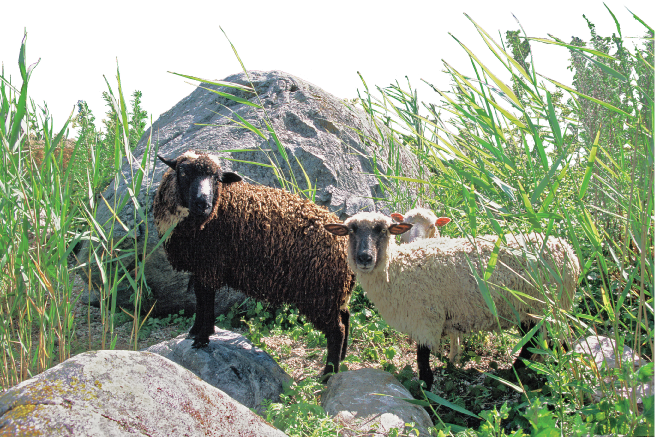
To preserve the meadows and sparse juniper woodlands of Saarnaki, hay is mown and sheep are grazed. Both machinery and sheep are brought and taken away by boat or on a pontoon raft towed by a boat. The islet is divided into two – in the southern part hay is mown and harvested, while sheep trim the scrub in the northern part. While sheep choose softer and tastier plants when feeding, mowing gives all herbaceous plants equal growing opportunities. Thus, more capricious species that would otherwise perish in competition or be eaten by sheep also survive. For example, orchids are considerably more abundant in mown areas.