
Moist Alvar Meadow
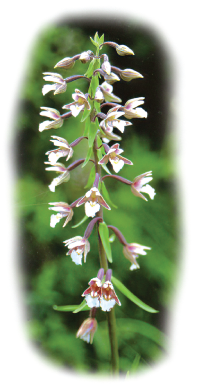
Moist Alvar Meadow & Marsh Helleborine (Epipactis palustris)
Blooms July–AugustImmediately before the beach, surface water gets trapped in the depression behind the coastal ridge, which periodically, especially in spring, is saturated with surface water, but dry in summer. As a result, a moist alvar meadow has developed here.
In the part of the moist alvar meadow on the side of the "world of people", the lime- and moisture-loving marsh helleborine (Epipactis palustris) blooms in July-August. Many plants often grow together on a long branching rhizome. The color of the flowers varies in different habitats from reddish to brown; a light-flowered form also occurs. The most striking part of the flower is the lip resembling a white lace apron, which springs like a diving board to push the insect headfirst into the sticky pollen. Folk tradition has also called this plant "külmkingarohi" (chill-shoe herb), which was supposed to protect the living against the unwanted influences of a revenant spirit (külmking).
Fragrant Orchid (Gymnadenia conopsea)
Fragrant wild orchidAnother orchid growing on moist meadows is the fragrant orchid (Gymnadenia conopsea), whose cylindrical clove-scented inflorescences ranging from dark pink to white can be seen from early June to late August. Folk names for this species, such as "Jesus' thumb", "bear's paw", and "heavenly father's hand", probably come from its palmate root tubers, which unfortunately taste all too good to wild boars.
Marsh Lousewort (Pedicularis palustris) & Sedges
Semi-parasitic plant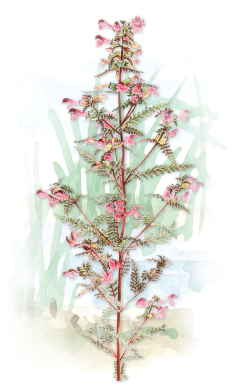
There are several other species characteristic of a moist alvar in the observed area, such as blue moor-grass (Sesleria caerulea), whose leaves seem covered with a grayish film, glaucous sedge (Carex flacca), and purple moor-grass (Molinea caerulea) with a slightly bluish-tinged panicle.
Here also grows marsh lousewort (Pedicularis palustris) with pink labiate flowers and dark red lacy leaves, which as a semi-parasite sucks nutrients from sedges with its roots.