
Orchids
Wild Orchids (Orchidaceae)
All species strictly protectedTowards the sea from the trail lies a moister alvar juniper woodland where several orchids grow. These plants are predominantly insect-pollinated, using nectar to attract insects or luring pollinators with a scent that imitates food or an opposite-sex conspecific, depending on the species. A single plant can produce millions of seeds, but they are without nutrient reserves and require the presence of a species-specific mycorrhizal fungus under specific growing conditions to germinate.
Slow development from seed to flowering (up to 15 years in some species), ornamental appeal, and sensitivity to changes in growing conditions are why all orchids in Estonia are protected and picking them is prohibited.
Military Orchid (Orchis militaris)
Blooms May–JuneFour species of orchids grow in the observed area. The earliest of these to bloom (in May–June) is the military orchid (Orchis militaris), quite common in Western Estonia, whose pinkish flower resembles a helmeted soldier.
In June–July, the whitish and especially evening-scented inflorescences of the greater and lesser butterfly-orchids (Platanthera chlorantha and P. bifolia) appear. In the lesser butterfly-orchid, the anthers are close together and parallel, whereas in the greater butterfly-orchid, they form an upside-down V-shape, converging at the top and diverging below. The greater butterfly-orchid almost completely lacks a scent.
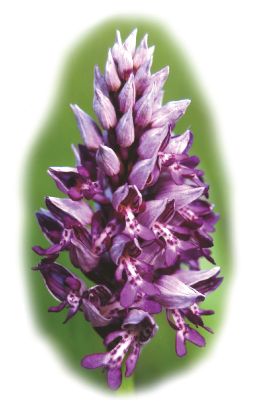
Fly Orchid (Ophrys insectifera)
Rare deceptive mimic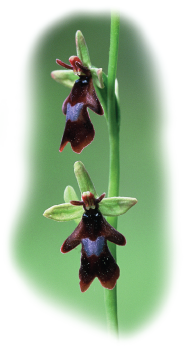
At the same time, one can also find the rarer fly orchid (Ophrys insectifera) in the grass, whose dark brown flowers resemble insects sitting along the stem.
The flower's shape, coloration, and specific pheromone-like scent attract and entice young males of certain digger wasp species to "mate". Deceived by the plant, the insects transfer pollen as they fly from flower to flower.
Accompanying Plants & Carnivorous Butterwort
Alongside the orchids, bird's-eye primrose and tormentil grow here. The latter is distinguished from other cinquefoils by having four petals on its yellow flower.
A plant of interest in its own right is the purple-flowered common butterwort (Pinguicula vulgaris), on whose fleshy sticky leaves one can always find traces of its last meal – the husks of tiny insects.