
Alvar juniper woodland
Alvar grasslands and juniper woodlands
Semi-natural habitat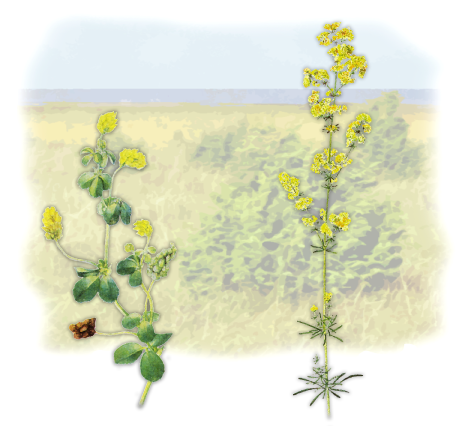
From here on, the nature trail mostly runs through alvar juniper woodlands. These are alvar grasslands where junipers began to grow after human impact decreased. Alvars are grasslands that have developed on limestone areas with thin soil and on limestone-shingle coastal ridges. Alvars are mostly semi-natural, meaning they developed and persist only through continuous appropriate human influence, such as grazing livestock, mowing hay, and selectively removing trees and shrubs.
On the alvars grow junipers (Juniperus communis), Scots pines (Pinus sylvestris), rowans (Sorbus aucuparia), and European ashes (Fraxinus excelsior). Notable are old tree-shaped common buckthorns (Rhamnus catharcticus).
In the herb layer grow wild strawberries (Fragaria vesca) and creamy strawberries (F. viridis) with gray-hairy leaves, several yellow-flowered species such as thick-leaved biting stonecrop (Sedum acre), black medick (Medicago lupulina) with small flower heads, and lady's bedstraw (Galium verum), and of grasses, red fescue (Festuca rubra), sheep's fescue (F. ovina) with stiffer leaves, flattened meadow-grass (Poa compressa) with flattened stem and panicle, etc.
Creeping thyme (Thymus serpyllum)
Medicinal & sacred herbCertainly one of the most noteworthy plants is creeping thyme (Thymus serpyllum) with small leaves and pinkish-purple flowers, which often forms ground-hugging cushions consisting of a single plant. Creeping thyme blooms from July to September; rarely, the flowers can also be white.
Even the ancient Egyptians knew the antiseptic properties of this medicinal plant and used it in embalming. At various times, different nations have regarded creeping thyme as the epitome of refined elegance, imparting courage and vitality, warding off nightmares and shyness. In the Middle Ages, thyme was a sacred plant and was an ingredient in magic potions that granted the ability to see the other world.
