Stoat and grass snake
Stoat (Mustela erminea)
Protected species (Category III)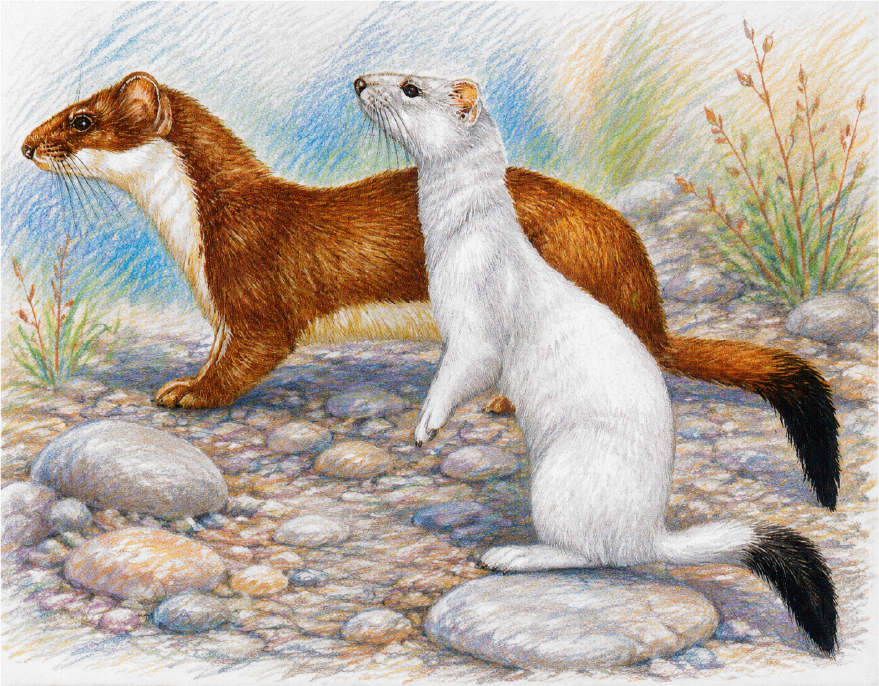
When the yard is quiet and peaceful, you might also meet the residents here. On the stone wall, a small stoat (Mustela erminea) with a long, slender body often scurries about, fearless of visitors, but certainly keeping an eye on them. It is a small predator with a chestnut-brown coat on top and yellowish-white below. Body length is 16…38 cm, about half of which is the tail. It is distinguished from the least weasel by its black tail tip, which stays black even in winter when the animal's coat turns white.
The stoat lives solitarily. It prefers to be active at twilight. Its habitat is often on the border between two different areas (field or forest edge, near houses, near rock piles), where its primary prey – mice – is most abundant. It readily eats birds and frogs as well. With good luck, a stoat can kill animals larger than itself, such as hares.
Stoats have no set mating season. The young are born from April to June and there can be 3…9 in a litter. Litters disperse in autumn. A stoat can live up to 12 years, but on average about five years. Enemies of the stoat are larger predators, mainly the fox. The stoat is protected by law (Category III). Stoats can be encountered here year-round.
Grass snake (Natrix natrix)
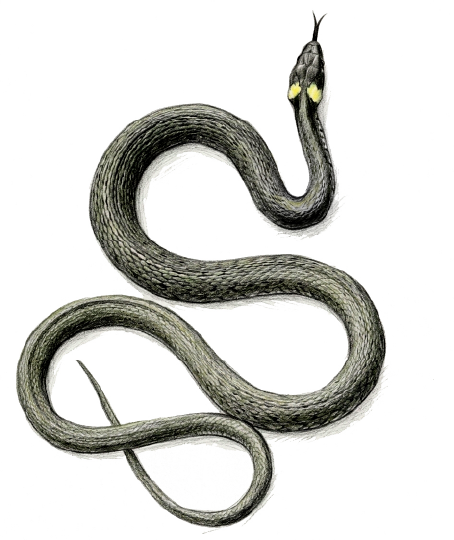
Protected species (Category III)Grass snakes are usually seen in the yard in spring after waking from hibernation. They gladly spend the summer in reed beds and other coastal areas. The grass snake (Natrix natrix) is a dark-colored snake with yellow or dirty-white patches on the sides of its head. Individuals can reach lengths of up to 150 cm, males only up to 70 cm. In Estonia, the grass snake is distributed in the western part, coastal areas, and islands.
The grass snake's primary prey consists of frogs and tadpoles, but also lizards, nestlings, or small mammals, rarely fish. The grass snake can live without food for a long time. Hibernation occurs in deep burrows either singly or in groups (sometimes together with adders).
In the wild, the grass snake has plenty of enemies – short-toed snake eagles, storks, foxes, martens, etc. To fool an enemy, the grass snake can play dead, belly turned upwards and tongue hanging out. The grass snake is protected by law (Category III).